TL;DR
- A postcard should introduce the actual buyer, explain the interest in buying and give the owner a clear way to respond.
- These three front-and-back diagrams are invented teaching examples, not tested winners, customer mail or current Homebase templates.
- Match the inquiry to the audience without declaring a private problem or assuming the owner wants to sell.
- Test one defined change when you want to isolate it, and keep responses separate from qualified opportunities and purchases.
How to read this gallery
The diagrams below show the front and the message area on the back together. Numbered annotations connect identity, response number and seller-page continuity. They are original conceptual layouts, not print-ready files: contact placeholders are deliberately nonfunctional, and postal address, postage and production layout are not specified. Have the final proof checked against the chosen mailing service’s current production requirements before use.
The examples use the fictional buyer name “Example Home Buyer.” Replace it with the real buyer identity only when preparing actual creative. Do not copy another company’s experience, photos or promises. None of these examples claims that an owner is distressed or that a purchase is already approved.
Example A: an open buying inquiry
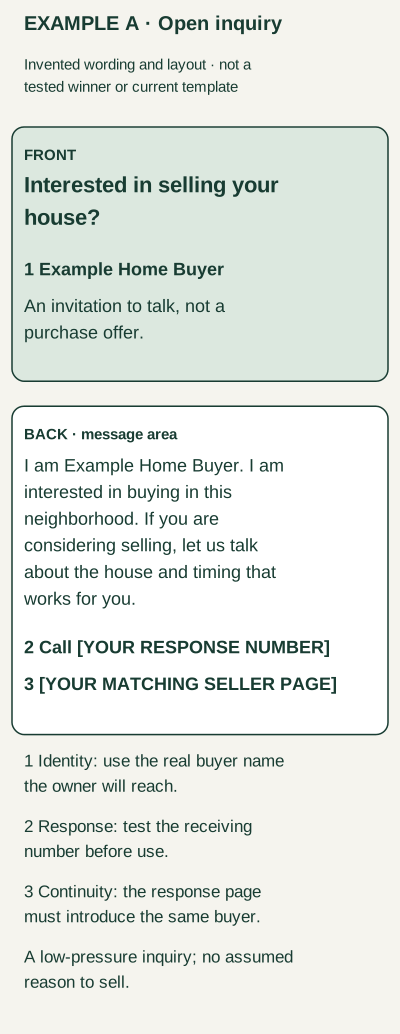
Front headline: Interested in selling your house?
Back message: I am Example Home Buyer. I am interested in buying in this neighborhood. If you are considering selling, let us talk about the house and timing that works for you.
Response placeholders: Call [YOUR RESPONSE NUMBER] · [YOUR MATCHING SELLER PAGE]
Invented example A: the front asks a simple question; the back identifies the buyer, explains the interest and supplies matching response paths. This is not a current product template.
Use this as the general starting concept when you have not established an audience-specific reason to change the wording. “If you are considering selling” lets the owner decide whether the conversation is relevant. It does not pretend that a property record reveals the owner’s plans.
The testable question is whether the front makes the buying inquiry easy to understand. A controlled challenger could change only the front headline while keeping the audience, back, buyer identity and response path stable. Do not label that a test of copy if you also change the mailing audience and contact destination.
Example B: a rental-property inquiry
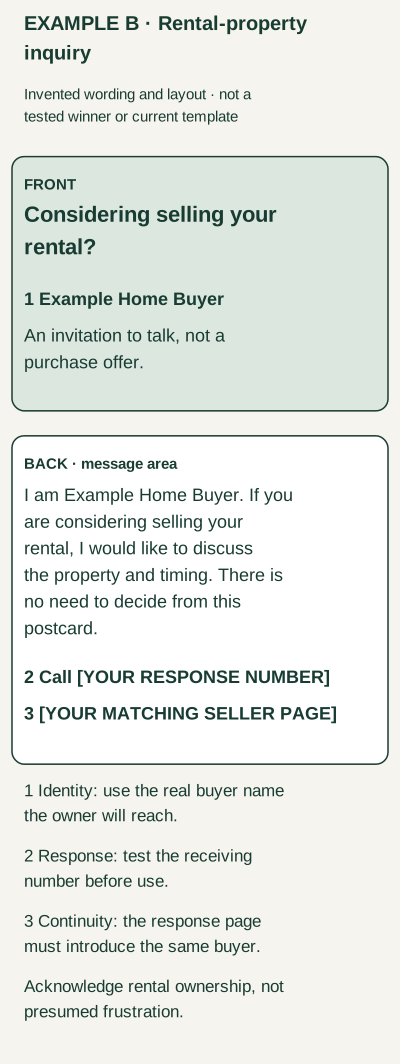
Front headline: Considering selling your rental?
Back message: I am Example Home Buyer. If you are considering selling your rental, I would like to discuss the property and timing. There is no need to decide from this postcard.
Response placeholders: Call [YOUR RESPONSE NUMBER] · [YOUR MATCHING SELLER PAGE]
Invented example B: rental ownership informs the topic, but the card does not assume tenant trouble, frustration or a need to sell. It is not a claim about a real owner.
A rental inquiry can discuss the property as a rental without saying “tired landlord” or assuming the owner wants out. The back keeps timing open and does not try to negotiate a sale before a conversation.
Use this concept only where the rental reference is accurate. If you are unsure of occupancy or ownership, an open inquiry is more honest than confident personalization. Verify the property you want to buy separately from the address where the owner receives mail.
This example changes the audience-specific premise, not just typography. Do not compare it with example A sent to a different audience and conclude that the wording caused any difference in response.
Example C: a timing-led conversation
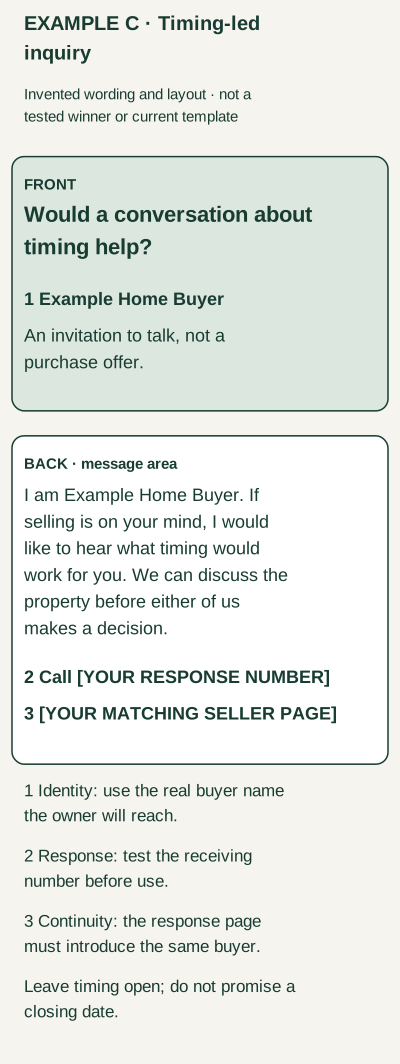
Front headline: Would a conversation about timing help?
Back message: I am Example Home Buyer. If selling is on your mind, I would like to hear what timing would work for you. We can discuss the property before either of us makes a decision.
Response placeholders: Call [YOUR RESPONSE NUMBER] · [YOUR MATCHING SELLER PAGE]
Invented example C: the invitation is about discussing timing, not promising a closing date. The owner reaches the same buyer introduced on the card.
This concept leaves space for an owner who may be considering a sale but has not settled on when. It does not promise a cash offer, a guaranteed price or an arbitrary fast closing. Those claims require facts the diagram does not establish.
A useful controlled test could keep the audience and back unchanged while comparing a timing-led front with the general buying question. Record exactly what changes. If you replace the whole message, report a comparison of complete versions rather than attributing a result to one headline.
Check the three numbered connections
1 — Identity: The name on the front, the person answering and the seller page should introduce the same buyer. A handwritten-looking style is not evidence that the card was individually handwritten. Do not imply otherwise.
2 — Response number: Test the printed number on the final proof. Confirm where it rings, who answers and what happens when no one can answer. Add a text invitation only if that response path is actually supported and staffed.
3 — Seller-page continuity: Open the exact printed web address or QR destination on a phone. Verify the buyer identity, contact link and form delivery. Do not check only the home page when the card points somewhere else.
The copy-and-trust lesson develops the message and proof checks. The design walkthrough explains how front, type and message work as a combination. This gallery makes those relationships visible; it does not replace those lessons or claim a new performance finding.
A one-change testing worksheet
Complete this before mailing. Use the same observation period and written outcome definitions for both versions.
| Field | What to record |
|---|---|
| Question | The specific difference you want to learn about |
| Audience | Who is eligible, how versions are assigned and how duplicate owners are handled |
| Control and challenger | Saved front/back proofs and the single planned difference |
| Stable conditions | Buyer identity, response handling, timing and other conditions held comparable |
| Send record | Actual pieces, versions and send dates, with delivery limitations noted |
| Observation | Unique responding owners, wrong-party contacts and stop requests, recorded separately |
| Later outcomes | Qualified seller opportunities, appointments, offers and purchases, without combining them |
| Decision | Continue, revise or gather more evidence, with uncertainty retained |
If an invented test sends 200 pieces of each version and gets two responses to one and three to the other, the observed response rates are 1% and 1.5%. That small difference is not enough on its own to call a reliable winner or forecast a deal. It also says nothing about which version produces a useful seller conversation. The numbers are invented arithmetic, not Homebase results.
Before choosing creative, choose an audience you understand and a response process you can support. Start with your first neighborhood analysis free. Mailing is paid; these diagrams do not describe a free print offer or promise that every illustrated creative can be selected in the product.
Direct mail to the neighborhoods where you want to buy
Homebase handles direct mail to property owners in the neighborhoods where you want to buy. Enter one address to find your neighborhood and get your first neighborhood analysis free. No card required.
Analyze a neighborhood free