Compare two Chattanooga neighborhoods by using the same property type, the same sales window and clearly drawn boundaries. Then check the individual properties that could change your costs. A neighborhood name or a countywide price average is not enough to decide where to mail.
The goal is a comparison you can explain: which houses fit your project, what supports the resale assumptions, and which unanswered questions could change the decision.
TL;DR
- Save the exact boundaries of both areas before comparing them; a familiar place name can hide a different set of streets.
- Use the same house characteristics and sale dates on both sides, and keep unsuitable sales out of the comparison.
- Check local parcel, flood and permit information at the property level instead of assigning one condition to an entire neighborhood.
- Record missing evidence as unknown. Choose the next research step before committing to a mailing budget.
Start with the boundary you will actually use
Use the City of Chattanooga GIS directory to open its current Chattanooga Map Viewer. The city describes it as a source of parcel information and other city mapping data. Save the area you inspected and the date you inspected it.
If you are comparing areas in Homebase, use the neighborhood outlines shown in the product. Keep each selected neighborhood separate. A local nickname, a neighborhood association boundary and the area available for selection can describe different sets of houses.
Write the boundary beside each comparison. “North Chattanooga” on one sheet and a hand-picked group of similar houses on the other is not a fair comparison just because both sound local.
Build two columns with the same rules
Decide what kind of house you can actually renovate before looking for a winning neighborhood. A small detached house and a large new build should not become interchangeable simply because both sold nearby.
Use a worksheet like this. The entries are research instructions, not current market measurements.
| Comparison item | Area A | Area B |
|---|---|---|
| Boundary and date saved | Exact selected area | Exact selected area |
| Target house | Same type, size range and scope limits | Same rules |
| Sales window | Chosen start and end dates | Identical dates |
| Usable comparable sales | Count and explain each inclusion | Apply the same checks |
| Rejected sales | Record the reason | Apply the same exclusions |
| Property-level questions | Flood, permits, access or other unresolved costs | Same checklist |
| Evidence still missing | Name the missing item | Name the missing item |
| Next step | Research, narrow the area or proceed | Research, narrow the area or proceed |
The Hamilton County Assessor's search can help you locate parcel records; its search instructions allow a street search without a house number. Use the record to check that you are looking at the correct property. The assessor describes its valuations as being for assessment purposes. A tax value is not a substitute for a supported resale estimate.
When you use sales from another source, record the source, the dates covered and the filters. An export's record count describes that export. It does not automatically describe every sale or every suitable house in the area.
Check the exceptions that a neighborhood average conceals
Chattanooga's property flood-risk service links to a property search with flood-zone and elevation information. Look up the property you are evaluating. Do not treat a result for one address as the answer for all the surrounding streets. An unresolved result stays unresolved until you have the information needed for the decision.
Renovation assumptions also deserve a local check. The city's residential modification permit page covers specified changes to existing structures without changing the footprint. If your plan involves a different scope, confirm the appropriate process with the office responsible for that property. A mailing address alone does not establish which office governs the work.
These checks help you identify a cost or process question before it becomes a confident-looking spreadsheet input. They do not prove an owner wants to sell.
Use an uneven sample without forcing a winner
Suppose a fictional comparison produces eight candidate sales in Area A and four in Area B. After checking house type, condition and dates, only two of A's sales fit your rules, while three of B's do.
That gives you a better-supported comparison set in B under these invented assumptions. It does not prove B is cheaper, will appreciate faster, or will produce more seller responses. A had more records; B had more usable records. Those answer different questions.
If A still interests you, widen the time window deliberately and do the same for B, or narrow your buying criteria and repeat the check. Record the change. Do not quietly relax one side until it supports the choice you already wanted.
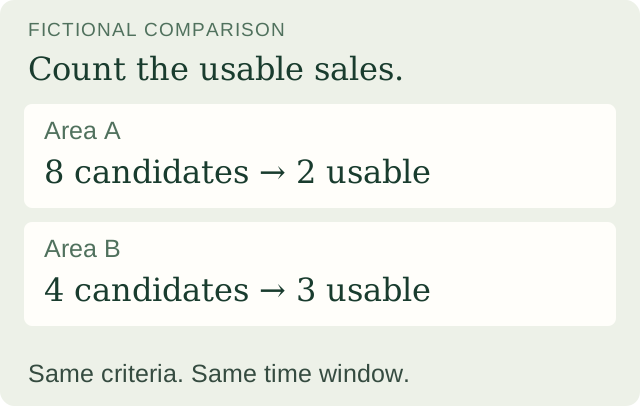
Both sides use the same criteria. These are invented counts, not current Chattanooga market data.
Keep a decision log instead of a neighborhood score
A single score can hide the reason an area looks attractive. Keep four short lines with the worksheet:
- What fits: the house type and scope you know how to evaluate.
- What supports the numbers: the actual sales you kept, with dates and source.
- What might change the decision: a property condition, boundary mismatch, permit question or unsupported cost.
- What happens next: obtain the missing evidence, change the search consistently, or pass on the area for now.
If you cannot explain the resale assumption, choosing a larger mailing list will not fix that uncertainty. Resolve the question that could change what you can pay before treating the area as ready for a campaign.
Does a familiar Chattanooga neighborhood name define the list?
No. Save the actual selected boundary and compare that same area throughout the research. Use the local name to communicate, then use the map and property records to establish which houses your comparison includes. If a public map layer and the product outline differ, record the difference instead of treating them as interchangeable.
Make the mailing decision from the research you have
Before choosing an area, you should be able to show its boundary, explain your comparable-sale rules, identify the property conditions that still need checking, and describe the kind of project you can buy there.
Open Homebase's neighborhood explorer with that comparison beside you. Review the current product information before selecting anything. Neighborhood research helps you decide where to investigate; it does not guarantee a deal, an owner's interest or a campaign response rate.
Local reference pages checked October 31, 2026. No live neighborhood sales counts or property recommendations are asserted in the fictional comparison.
Direct mail to the neighborhoods where you want to buy
Homebase handles direct mail to property owners in the neighborhoods where you want to buy. Enter one address to find your neighborhood and get your first neighborhood analysis free. No card required.
Analyze a neighborhood free